
Monsterpieces: Anti-Towers
Part I


Towers? Photographs?
Some of the last words of Gravity’s Rainbow, my main and abiding monsterpiece, are “brought the Towers low.” Probably initially referring to the rockets in the novel, “Towers” are also Pynchon’s symbol of humans’ historical desire to rise above and escape the earth, find redoubts of safety, construct high cities, assert power. If Towers do represent power, Monsterpiece fictions are often anti-Towers: massive monstrosities that use their bulk—their height, if you will—as “counterforce” (Pynchon’s word) against some monstrously powerful aspect of contemporary culture: environmental destruction in Gravity’s Rainbow, Ducks, Newburyport, and Elkins’ Weak in Comparison to Dreams; fascism in The Public Burning and The Tunnel; addictive entertainment in Infinite Jest; male domination in Dewitt’s Your Name Here and Tokarczuk’s Books of Jacob; the American intelligence apparatus in Vollmann’s A Table for Fortune.
Since publishing Passing Again, a minor monstrosity with 50 photos, and since living with a professional photographer, I’ve become increasingly interested in photographs. I’ve been reviewing photobooks for Open Letters Review, and I wrote the foreword and afterword for my partner’s photobook Framing the World. I’ve also been taking photos of towers—those in this gallery and in the gallery that follows in Part Two. There are more on my Instagram—@thomas.leclair—but they are mixed in with other photos, and the ones here (also in the carousel on IG) are most illustrative of Anti-Towers. I know you signed up for textuality, so along with the photographs is an interview with Michael Streit about them. Perhaps think of this post, which is not about long fictions, as summer vacation: postcards from famous sites.
I don’t know what makes a photo a monstrous. You may think of mine as monstrosities because almost all of the views of the sites are obstructed. I might have tried to publish these photos on some photography site, but they were shot with an old iPhone and may not be sufficiently professional in pixel quality. And besides, I came to believe subscribers to Monsterpieces were the appropriate—and might be an appreciative—audience for Anti-Towers mixed media.
I became acquainted with Michael when I appeared on the podcast “Don DeLillo Should Win the Nobel Prize,” which he co-hosts with Jeffrey Severs. When I discovered Michael was interested in photographs in fiction, I sent him a copy of Passing Again. We corresponded about it, I sent him some photographs of towers, and eventually we decided to turn some of our questions and answers about towers into this interview for Substack. Michael is currently in the midst of what his podcast is calling The Summer of Underworld, a six-part series gathering multiple perspectives with which to view and appreciate DeLillo’s ambitious epic.
Streit: How did you get interested in photographing famous high buildings?
LeClair: Maybe it was when I spent every day for two months in 2016 and 2017 holding up protest signs in front of Trump Tower, the symbol of ill-gotten gain and destructive power, a Babel that should be brought low.
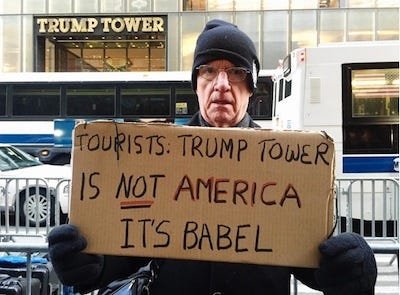
Streit: You now live with the professional photographer responsible for most of the images in Passing Again. What was her influence on your photographs?
LeClair: She takes perfect photographs. I wasn’t going to compete with that, so I started taking “imperfect” shots, “perfect” views obstructed, defaced. Really, though, it was the books she recommended that got me thinking about those obstructions. Roland Barthes’ Eiffel Tower and Other Mythologies was particularly influential, his discussion of abstraction.
Streit: The relation between obstruction and abstraction? Just a couple of vowels different.
LeClair: Yeah, I wasn’t used to thinking as abstractly as Barthes, not about photographs, so he was a big help even if I came to disagree with him a bit about the Eiffel Tower. I first thought of my obstructed photographs as “realistic seeing.” In cities, we don’t often see anything, including famous buildings, from an ideal and uninterrupted perspective. Walking the streets of Paris, for example, one gets unexpected glimpses--with various kinds of interference or obstruction—of the Eiffel Tower until one can maneuver into postcard-shot position to take a conventional unobstructed photo.
Streit: But when a photographer quite obviously chooses the obstruction or allows it to happen, the photograph solicits interpretation—and that means linguistic abstraction.
LeClair: Right. In The Eiffel Tower and Other Mythologies, Barthes wrote a definitive discussion of the abstractions elicited by a view of the Tower and the ideas generated by a view from the Tower. Because its construction had no practical purpose, he calls the Tower “useless”—except as an empty “pure signifier” waiting to be filled. History offers one “filler,” and Barthes discusses the background of the Tower’s construction and the motives for tower-building going back in history to the Tower of Babel. In the first photograph in the gallery, obstructions, I now realize with the help of Barthes, call the viewer’s attention to the historical foundation of the Tower, a foundation older than Babel.
Streit: The leaves on the right side of the photograph obstruct the peak of the Tower, making it look unfinished, still a work in progress. The different leaves on the left reinforce the natural element in the scene, but what do you mean by “foundation?”
LeClair: The obstructions are meant to shift attention from the Tower itself to other elements in the photograph. The whole bottom quarter of the photo, unfortunately cropped in the Substack gallery, appears to be, like the leaves, “noise.” Except that bottom “noise” is history--implied by the cropped Seine, the boats limited to its surface, and the bridge across it, which predates the Tower. Above the bridge is a more substantial band of nature, a line of trees. All these elements are foundational, for the Tower seems to rise—seems to “grow”—from them, arrowing upward and narrowing like a tree trunk.
The Tower may have been “useless” for commerce, but the signifying Tower represents a natural--and historical--human urge to escape nature, to mimic humans’ erect posture, and, once down from the trees, to find safe high places where forts and castles and temples and churches are built.
Streit: And you considered this urge abstraction?
LeClair: Right, escape from or transcendence of the concrete, the complicated specificity of earth at ground level, the “noise” at the bottom of the photograph. And with its open steelwork and regular stages, the Tower seems to me abstracted from concrete solidity and hybrid complication. The Tower is like an architect’s sketch of a building. The surface world is dense. One can see through the Tower, as one “sees” the world through frames and concepts. The higher the view, the closer one is to the almost featureless blue heaven in the photo. And the further one can see from the Tower, distance transforms the surrounding concrete sights into abstract forms, mountain here, river there. The novelist Walker Percy called this cognitive or intellectual abstraction “angelism,” not quite godly but a rung up from humans on the great chain of being and seeing.
Barthes says the tower is a “concrete abstraction” but can I humbly say I don’t believe he has that quite right. I think the photograph uses obstruction and noise to remind its viewers that the Tower rose from the concrete and to imply that it rose over Paris as an abstraction, a powerful symbol of secular human thought to challenge the power of the faith-aided and exceedingly concrete Sacre-Coeur high on Montmarte.
Streit: So hardly “useless?”
LeClair: Certainly not for me, the neophyte. The structure is a useful meta tower—a tower about and asserting the power of towering--that helped me understand some implications of obstructions in the photographs of more conventionally functional buildings that follow. But first, what do you make of the companion shot?
Streit: I guess it shows that distance definitely does create abstraction. The obstructing glass—either frosted or just dirty—helps. Though diagonal, the metal framing also helps make this a companion shot, for we are seeing through a building at a structure that looks rather small.
LeClair: True all, but I also include this one because I’ve begun to wonder if my old iPhone 8--its glass, its lens--is itself an unavoidable obstruction and partial cause of abstraction. A better camera might have changed the feel of all these photographs, made the concrete sharper, more concrete.
Streit: So why do you continue with the iPhone?
LeClair: I think I have resisted buying a “real” camera to preserve “realistic seeing,” the seeing and shooting most people do with their cell phones. But I’ve come to realize there’s a cost in pixels.
Streit: The focus of the next one in the gallery—the combination of far and near--might have been improved with a different camera.
From obstruction to abstraction, you say. Let’s see. Perhaps the first abstraction this viewer’s mind articulates to itself is the contrast between inanimate stone and live nature that both obstructs and frames the Parthenon. The obstruction might also initially elicit a different, formal abstraction—the straight lines and symmetry of the temple versus the irregularity of the branches.
LeClair: Once you get started there are plenty more. There’s the possibility of spatial abstraction: the high versus the low, as well as the far versus the near and the periphery versus the center. Also possible is the contrast of scale: from this perspective, the Parthenon is much smaller than the other main building (with some similar lines) in the shot. In fact, the Parthenon is about the size of a large leaf. The mind, if not color blind like mine, might also note the contrast in color.
Eventually, I trust, the viewer’s mind will get round to another level of abstraction: shifting from thinking about the (after all) concrete photograph on the page or on the screen to thinking about the photographer, an invisible and therefore highly abstract being. Why, the obstructed viewer may well wonder, did the photographer take such a limited shot of the Parthenon? Maybe for “realistic seeing” or the contrasts we’ve suggested, but also perhaps for some other reason not readily apparent, which means interpretation edges into Barthesian speculation and further, possibly “higher” abstraction.
Streit: One reason I can imagine is to convert seeming artlessness (“Why didn’t the photographer just move away from the tree?”) into art—an abstraction usually associated with originality.
LeClair: Exactly. The tree-obstructed shot is unusual, perhaps original, and may offer a new way to see the Parthenon that has been photographed thousands or millions of times. But what might be the effects beyond the viewer’s possibly grudging appreciation of this presumably intentional novelty?
Streit: You ask quite a lot of the viewer who may just dismiss such a shot as awkward.
LeClair: That’s why you’re here, the curious, patient viewer. I’m going to lean on Walter Benjamin’s famous term “aura.” One can say this kind of art photograph diminishes the powerful aura of the Parthenon, subtracts or minimizes some of the many abstract associations viewers have with this famous site now occupying only a small share of the photograph. That is, the “artless” obstructed shot treats the Parthenon like any other high building one might glimpse if we were walking around the generally low-built streets of Athens. That abstract personage, the photographer, has moved the Parthenon from the usual foreground to the background and in doing so has made an abstract building concrete, one small part of the sprawling concrete city one sees from the Acropolis. This connection to the city is one that viewers may forget when seeing the building or photographs of it up there on high.
Streit: The change in status is somewhat different from the concrete/abstract relations in the photograph of the Eiffel Tower that emphasizes the abstract arising from the concrete.
LeClair: Yes, here the Parthenon “sinks” from the abstract to the concrete, loses rather than gains power over the viewer’s consciousness.
Streit: The Parthenon has suffered partial symbolic deconstruction by the obstruction.
LeClair: I thought I could count on you for introducing “deconstruction.” Maybe this is a wish, but the photographer would like to think the viewer will wonder about construction, how the now concrete building sitting on stone was constructed of other stones millennia before the poured concrete that surrounds the Acropolis. (By the way, if the viewer had walked all the way around the Acropolis, they would have realized that it is also surrounded by greenery, yet another reason why the photographer may have taken the shot.)
But back to the concrete thing itself, the physical construct before it gathered its numerous abstract cultural associations and became a powerful “wonder of the world.” (It’s hard to get any more abstract than that phrase.) So, my ideal viewer following the “-tion” rhymes asks: what were the obstructions when the marble was quarried and then hauled ten miles from Mount Penteli? What were the impediments shaping the stone into columns and statuary? What were the difficulties creating the building’s precise geometrical relationships?
Streit: Athena, to whom the Parthenon was dedicated, had something like a virgin birth from Zeus’s head and was herself a virgin, thus the name of the building. Its design was abstract and even visionary, but you want to suggest its construction was far from abstract.
LeClair: The Parthenon did not come into being fully formed. The basic structure came to be little by little over more than a decade of labor. Further years were required to carve and mount the statuary. Seeing the Parthenon obstructed can be realistic seeing, but more importantly, at least for me, this kind of seeing may lead one to appreciate the more than realistic—the indubitably real, specific, concrete labor that built the temple, hoisted those stones into a tower of the time. The obstructed photograph reduces one kind of aura and may create another: the aura of concrete difficulty and historical accomplishment. The grandiose temple of postcards shares the drive that built the Eiffel Tower, the urge to rise above the earth, but the temple in the photograph is more concrete, more humanized by the obstruction and the framing.
Tod Papageorge’s 2019 photobook On the Acropolis collects mostly images of people bleached out by white light and ignoring the Parthenon, treating the Acropolis as a place to look outward and get a tan. But he includes one image—in the gallery—that reminds the viewer of that ancient human aura I hope to recall.
Whenever I was up on the Acropolis, I was overwhelmed by the Parthenon, of course, but I was also struck by all the “extra” blocks of marble lying around on the ground. Now I see them as the absolute concrete, the random real, not part of any structure, the aura of separateness. But perhaps we should just avoid “aura” altogether. The Greek origin of “aura” was wind or breeze. The construction of the Parthenon was no breeze: it was sweaty and physical and lengthy. The Parthenon did not grow like the obstructing tree, but the tree and the building material do occupy the same abstract category—the world of substance that existed before the airy word “aura.” Maybe it was seeing the Parthenon every day when I lived in Athens, but I guess I’d like viewers to forget for a time the myths encoded in the Parthenon’s friezes, the famous architects and sculptors, the long history of various uses, all that written material that turned the stones into an extremely powerful abstract symbol of Greek and even western civilization. If viewers need the Parthenon to be a symbolic structure, remember the astonishing labor that created it. For me, all the abstractions plastered on the Parthenon obstruct appreciation of it as a heroic human-made thing that would be a powerful work of art even if it had none of the religious and cultural meanings coded in it and then projected on it.
Streit: I know you’re familiar with DeLillo’s take on “The most photographed barn in America” in White Noise where Murray Jay Siskind talks about the aura created by numerous photographs.
LeClair: Yes, for sure. I want to think my subjects, my towers, have more inherent cultural power than DeLillo’s barn that became an accidental postmodern “celebrity.” There’s not much reason to want to bring low the barn, unless you have a quarrel with pastoral nostalgia. By the way, if you Google “most photographed barn,” you’ll find one in Grand Teton National Park. Most of the photographs online have the modest structure large in the foreground, the massive mountains diminished in the background. The barn is no tower, but it does represent the human need to promote itself.
Streit: Speaking of possible literary influence, the next obstructed photo of the Parthenon could have been inspired by the eco-terrorist in your novel Passing Off.
LeClair: The green warrior, Eleni, yes. As you can see, the greenery covers about a third of the Parthenon, and tendrils without leaves may threaten to obstruct even more of the building in the future. If the previous photograph made the Parthenon part of the concrete city, this mass of greenery may imply that the Parthenon and the glimpsed city here are a small part of the larger world of nature—varied in this photograph--still existing and even sometimes flourishing outside of Athens. In the upper left corner of the photograph, one sees some small trees, a reminder of nature up on the Acropolis. The tendrils seem to be reaching toward the trees, as if to connect the mostly inanimate site with the organic obstruction. The powerful abstract aura of the distant wonder is again reduced, this time by contrast with the close-up concrete reality of the greenery.
Streit: The eco-terrorist wanted to bring down the Parthenon, a symbol for her of Athenian over-building and Greek over-dependence on tourism. In this photograph, the Parthenon still stands but no longer towers.
LeClair: Yes, it appears to be viewed from the same height, the perspective of Mount Likavitos, which actually stands higher than the Acropolis but has only a modest chapel on its peak. Also, the relation of the Parthenon to abstract heavenly blue here is reduced to a small corner of the photograph.
Streit: Your man DeLillo says in The Names that the offering the visitors bring to the Acropolis is language, numerous languages.
LeClair: Abstractions.
Streit: Like the ones we’re using.
LeClair: Because I feared the obstructed photos would be dismissed as artless.